
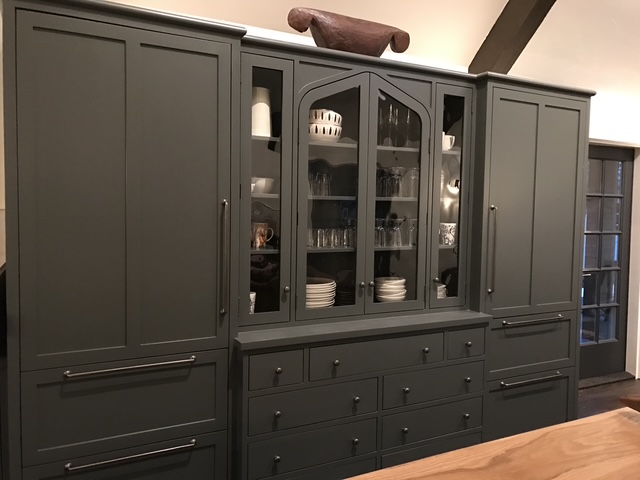
Cabinet painting looks simple from across the kitchen.
There are doors. There are drawers. There are cabinet boxes.
Count everything, choose a color, and you should be able to calculate the price.
But when we evaluate a cabinet painting project in Gresham, one of the most important questions isn’t how many doors you have.
It’s this:
What’s on the cabinets right now?
A kitchen with clean, factory-finished cabinets can present a very different project from cabinets that were stained decades ago, coated with layers of finish, or painted during a previous DIY renovation.
That’s why two Gresham kitchens with roughly the same number of cabinets can receive different estimates.
The amount of cabinetry matters.
The condition we’re starting with can matter just as much.
A Cabinet Door Is a Surface, Not a Number
Imagine two kitchens with 20 cabinet doors.
Kitchen A has relatively simple doors with a sound existing finish.
Kitchen B also has 20 doors, but they have detailed profiles, worn areas around the pulls, buildup near the stove, and an older coating that needs considerably more attention.
Twenty isn’t a very useful comparison anymore.
That’s why North West Painting’s cabinet painting and refinishing services begin with evaluating the actual cabinetry.
We’re not just counting doors.
We’re determining what those doors need before they’re ready for a new finish.
Previously Painted Cabinets Can Be the Wild Card
Here’s where cabinet estimates can become interesting.
A homeowner tells us, “They’re already painted, so this should be easier.”
Sometimes that’s true.
Sometimes it’s exactly the opposite.
We want to know how well that existing paint is attached.
Are there chips around handles?
Is the coating peeling along edges?
Are there visible brush marks?
Does the finish feel unusually thick?
Are there areas where the previous coating seems to scratch or release easily?
If the existing paint isn’t providing a reliable foundation, simply adding another coat doesn’t solve the problem underneath.
A beautiful new finish still depends on what it’s attached to.
The DIY Paint Job From Five Years Ago Still Counts
There is nothing inherently wrong with homeowners painting their own cabinets.
Plenty of people have successfully refreshed kitchens themselves.
But if you’re hiring a professional to repaint those cabinets later, the existing DIY work becomes part of the project.
Maybe the cabinets were cleaned and prepared carefully.
Great.
Or maybe paint was applied over a slick surface with minimal preparation.
Perhaps several products were used over the years.
Maybe hardware was painted around rather than removed.
We can’t price the new project as though that history doesn’t exist.
Sometimes we’re not starting with the original cabinets.
We’re starting with every decision made since they were installed.
Stained Wood Creates a Different Starting Point
Now consider traditional stained cabinets.
The goal may be to transform dark wood into a lighter painted kitchen.
Visually, that’s a dramatic change.
Technically, it also means we’re working with a different starting surface than cabinetry that has already been painted successfully.
Preparation and the appropriate coating system matter.
This is where cabinet painting stops being simply a color-change project.
The finish needs to adhere properly and perform on surfaces that homeowners touch, clean, bump, and use every day.
Kitchen cabinets aren’t walls.
They live a much harder life.
Grease Doesn’t Care How Clean Your Kitchen Looks
This is one of the less glamorous realities of cabinet painting.
Kitchens accumulate residue.
Even a well-maintained kitchen can have buildup around the range, above cooking areas, near handles, and on frequently touched doors.
Some of it is easy to see.
Some isn’t.
A cabinet can look perfectly clean from a few feet away while still requiring thorough preparation before coatings are applied.
This matters because paint needs a properly prepared surface.
Painting over contaminants can compromise adhesion.
So when we estimate a kitchen, we’re not judging anyone’s housekeeping.
We’re assessing the working surface.
Door Style Changes the Labor
Compare a completely flat cabinet door with one containing recessed panels, rails, edges, and detailed profiles.
They’re both one door.
They don’t necessarily require the same amount of work.
Detail affects:
- preparation
- application
- inspection
- finishing time
This becomes increasingly noticeable as the number of doors and drawers increases.
A highly detailed kitchen can require substantially more attention than a minimalist cabinet design with similar overall dimensions.
This is another reason online “price per cabinet door” formulas can be misleading.
They reduce a three-dimensional object to a tally mark.
Damage Is Different From Normal Wear
Small scratches and everyday wear are expected.
Actual damage changes the conversation.
During an estimate, we want to identify areas that may require additional attention before painting.
That could include damaged edges, deteriorated surfaces, or previous repairs that affect how the finished work should be approached.
We also want to be clear about the scope.
Painting improves and protects properly prepared surfaces, but it shouldn’t be presented as a magical cure for every underlying cabinet problem.
A good estimate should tell you what’s being painted, what preparation is included, and whether anything outside normal painting work needs to be addressed.
Color Can Affect the Project Too
Suppose your current cabinets are very dark and you want a substantially lighter finish.
Or you’re moving away from a strong existing painted color.
That transition may affect the coating process needed to achieve the desired appearance.
The same principle applies when painting other parts of the home.
Our residential interior painting services account for existing colors and surface conditions rather than assuming every color change requires identical work.
With cabinets, however, the expectations are often higher because they’re such a dominant feature of the kitchen.
You see them up close every day.
The Kitchen Still Has to Function
There’s another cost factor that doesn’t fit neatly into a square-foot calculation:
logistics.
A kitchen isn’t an empty room.
It’s one of the most heavily used spaces in the house.
Doors and drawers need to be handled systematically. Surfaces need appropriate preparation. Work areas have to be protected. The project has to be organized so pieces don’t become a giant puzzle halfway through.
The larger and more complex the kitchen, the more planning matters.
Professional cabinet painting isn’t just about producing a smooth finish.
It’s about controlling the process that gets you there.
What Can Make a Cabinet Painting Estimate Lower?
Not every variable pushes the scope upward.
Cabinetry with a sound existing finish, relatively simple door styles, limited surface damage, and straightforward preparation can be a less complicated starting point.
Good maintenance helps.
So does addressing a project before coatings are extensively failing.
And sometimes homeowners discover that the cabinets they thought were “in terrible shape” mostly need a cosmetic transformation rather than extensive corrective work.
That’s exactly why we prefer seeing the kitchen before making assumptions.
Why We Don’t Publish a Generic Cabinet Painting Price
People searching for “cabinet painting cost in Gresham” want a real answer.
We understand that.
But publishing one broad number creates the impression that kitchens are interchangeable.
They aren’t.
A small kitchen with simple, well-maintained cabinets isn’t the same project as a large kitchen with an island, detailed doors, older finishes, extensive wear, and a dramatic color transition.
North West Painting offers competitive pricing, and we’ll provide a free quote based on the cabinetry you actually have.
That gives you a number attached to a real scope of work instead of an internet average broad enough to mean almost anything.
Compare Cabinet Estimates by What They Include
If you’re collecting multiple estimates, don’t compare only the totals.
Ask what happens before the finish is applied.
How will the cabinetry be prepared?
How are doors and drawers handled?
What is included in the scope?
What products and process are being proposed?
How are surrounding areas protected?
What happens if an unstable existing coating is discovered?
Those answers help explain why two estimates can be different.
A cheaper proposal isn’t necessarily a bad proposal.
A higher proposal isn’t automatically better.
You need to know what you’re actually comparing.
Painting Versus Replacing Is a Different Conversation
Some homeowners start researching cabinet painting because they’re already considering a full kitchen renovation.
Painting can create a major visual transformation without replacing every cabinet, provided the existing cabinetry is a suitable candidate.
But that doesn’t mean every kitchen should automatically be painted.
If you dislike the cabinet layout, need substantial structural changes, or want an entirely different style of cabinetry, painting doesn’t solve those problems.
If you like the layout and functionality but dislike the finish, then professional painting becomes a much more interesting option.
That’s the decision worth making first.
Get a Quote for the Cabinets You Actually Own
The best cabinet painting estimate isn’t based on someone else’s Gresham kitchen.
It’s based on yours.
North West Painting works on residential painting projects throughout Gresham, Portland, and surrounding communities. You can learn more about North West Painting and the different painting services we provide.
If you’re considering updating your kitchen, contact North West Painting for a free quote.
We’ll look at what’s currently on the cabinets, their condition, their design, and the finish you’re trying to achieve.
Then we can provide competitive pricing based on the project in front of us.
Because when it comes to cabinet painting cost, counting the doors is easy.
Understanding what those doors need is where the real estimate begins.